William Blake Poems
- A Divine Image
- A Dream
- A Little Boy Lost
- A Poison Tree
- A War Song to Englishmen
- Ah! Sunflower
- An Imitation of Spenser
- Auguries of Innocence
- Blind Man’s Buff
- Broken Love
- Day
- Earth’s Answer
- England! awake! awake! awake!
- Eternity
- Fair Elanor
- Gwin King of Norway
- But in the Wine-presses the Human Grapes Sing not nor Dance:
- A Cradle Song
- Holy Thursday (Experience)
- Holy Thursday (Innocence)
- How Sweet I Roam’d
- I Heard an Angel
- I Rose Up at the Dawn of Day
- I Saw a Chapel
- I see the Four-fold Man
- If It Is True What the Prophets Write
- Infant Joy
- Infant Sorrow
- Jerusalem
- Laughing Song
- London
- Love and Harmony
- Love’s Secret
- Mad Song
- Milton: The Sky is an Immortal Tent Built by the Sons of Los
- Mock On, Mock On, Voltaire, Rousseau
- My Pretty Rose Tree
- My Spectre Around Me Night and Day
- Never Seek to Tell thy Love
- Night
- Now Art Has Lost Its Mental Charms
- Nurse’s Song (Innocence)
- Nurses Song (Experience)
- On Anothers Sorrow
- Piping Down the Valleys Wild
- Preludium to America
- Preludium to Europe
- Proverbs of Hell (Excerpt from The Marriage of Heaven and H
- Several Questions Answered
- Silent, Silent Night
- Song for the Rainy Season
- Song: Memory, hither come
- Songs Of Experience: Introduction
- Spring
- The Angel
- The Angel that presided o’er my birth
- The Birds
- The Blossom
- The Book of Thel
- The Book of Urizen: Chapter I
- The Book of Urizen: Chapter II
- The Book of Urizen: Chapter III
- The Book of Urizen: Chapter IV
- The Book of Urizen: Chapter IX
- The Book of Urizen: Chapter V
- The Book of Urizen: Chapter VI
- The Book of Urizen: Chapter VII
- The Book of Urizen: Chapter VIII
- The Book of Urizen: Preludium
- The Caverns of the Grave I’ve Seen
- The Chimney -sweeper
- The Chimney Sweeper
- The Clod and the Pebble
- The Crystal Cabinet
- The Divine Image
- The Echoing Green
- The Everlasting Gospel
- The Fly
- The Four Zoas (excerpt)
- The French Revolution (excerpt)
- The Garden of Love
- The Grey Monk (excerpts)
- The Human Abstract
- The lamb
- The Land of Dreams
- The Lily
- The Little Black Boy
- The Little Boy Found
- The Little Boy Lost
- The Little Girl Found
- The Little Girl Lost
- The Little Vagabond
- The Marriage of Heaven and Hell (excerpt)
- The New Jerusalem
- The Question Answered
- The School Boy
- The Shepherd
- The Sick Rose
- The Sky is an Immortal Tent Built by the Sons of Los
- The Song of Los
- The Two Songs
- The Tyger
- The Voice of the Ancient Bard
- The Wild Flower’s Song
- Three Things to Remember
- To Autum
- To Morning
- To Nobodaddy
- To Spring
- To Summer
- To The Accuser Who is The God of This World
- To the Evening Star
- To the Muses
- To Thomas Butts
- To Tirzah
- To Winter
- When Klopstock England Defied
- Why Should I Care for the Men of Thames
- Why Was Cupid a Boy
- You Don’t Believe
William Blake Biography
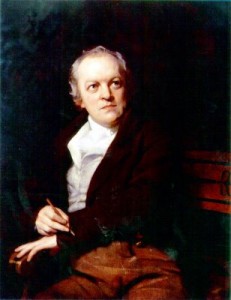 By turns whimsical and apocalyptic, brilliant and yet somehow simple, British poet William Blake (1757-1827) expanded the boundaries of poetry both with language and visuals to create a body of work that has become among the most beloved in the English language.
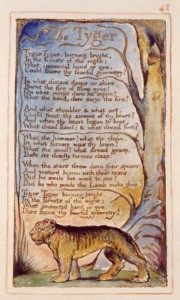
Known more for his visual arts than his poetry in his lifetime, Blake’s poetry was often illustrated by his own drawings and woodcuts. While illustrated books of poetry and prose were hardly unheard of in Blake’s time, Blake, dissatisfied with current methods of printing, began experimenting with the process itself, eventually creating new forms altogether.
One such example was called “illuminated printing.” According to the Royal Academy of Art, Blake’s illuminated printing process began with pages printed on copper plates that contained text within an image. After the page was printed, the illustrations were then colored with paint.
One of the most popular of Blake’s poems, “The Tyger,” can be seen below in an illuminated printing:
The text of “The Tyger” follows:
Blake, who despite his artistic and poetic talents, had little formal education and lived most of his life in abject poverty, broke other artistic molds, as well. He wrote of the plight of the poor from the perspective of a person living in poverty, and wrote in language that those with little or no education could understand. In the English literature of the late 1700s and early 1800s, this was almost unheard of.
A Christian keenly attuned to the suffering of others, particularly children, Blake’s Songs of Innocence was written largely from a child’s viewpoint. “The Chimney Sweeper” is an example:
Sometime later, Blake revisited Songs of Innocence, and the poems that were included in that book became Songs of Experience. See how “The Chimney Sweeper” has changed with experience:
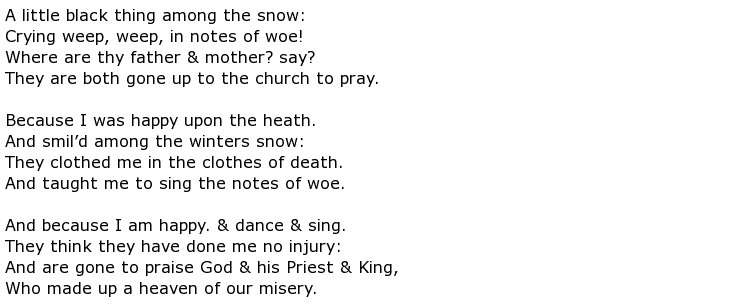
The hope the chimney sweeps have in Songs of Innocence is now gone. And the Father Almighty little Tom Dacre looked for has “made up a heaven of our misery.”
Blake’s poems run the gamut of subjects, from the dire lives of chimney sweeps in London, to the beauty of tigers in the wild, to the religious subjects he wrote about in “Jerusalem” and “The Marriage of Heaven and Hell.” Largely ignored during his lifetime, or considered insane for his mystical Christian writings, Blake was buried in an unmarked grave.